A Four-Point Check on a Mining Statement
A 377 TH/s rig should credit about $14.32 of gross output a day at the values read on 21 Sept 2026, which is $13.75 once the listed block-reward charge is applied. When a statement looks short, the fastest way to find out why is to check four points in a fixed order. It takes a phone, ten minutes and no trust in anyone's dashboard.
Key takeaways
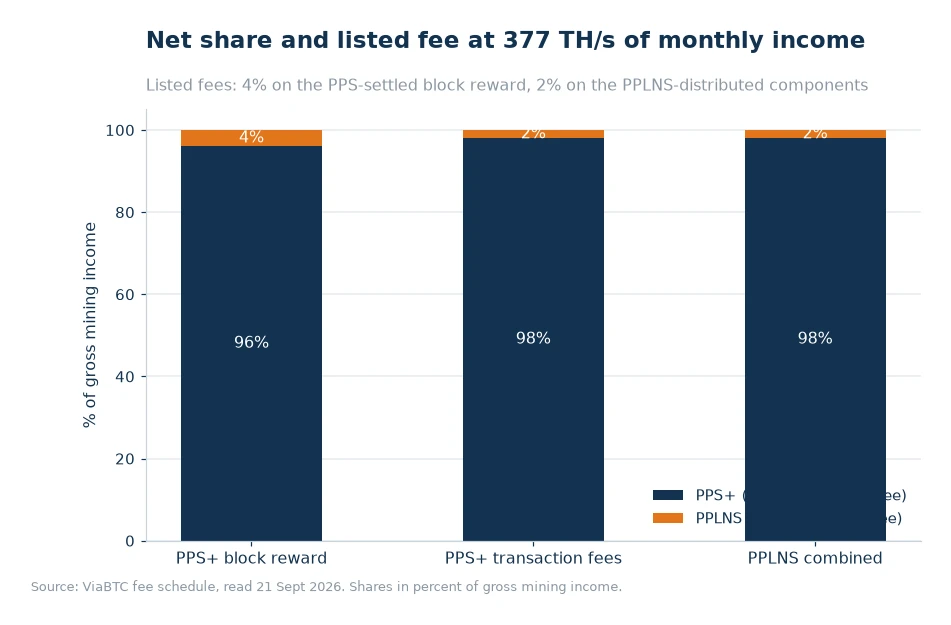
- At 377 TH/s the day is $14.32 gross; the listed 4% takes $0.57 and the listed 2% takes $0.29.
- Four checkpoints at 6, 12, 18 and 24 hours turn a vague worry into a specific discrepancy.
- PPS+ should show roughly 24 credits a day, so a single missing hour is visible without any tooling.
- Record the difficulty and price used, because a check without inputs cannot be repeated.
Begin with the rate, not the total
A total on its own says almost nothing. The same dollar figure can be correct at one difficulty and wrong at another, and the difference between a good month and a bad one is often the network rather than the pool. What can be checked is the rate: coins per day per terahash, multiplied by the hashrate the account actually reports.
The other half of the rate is the deduction, and the ViaBTC Pool Fees schedule defines it in two parts rather than one. Under PPS+, the block-reward component carries a listed 4% and the transaction-fee component a listed 2%. Under PPLNS, the combined amount carries a listed 2%. Write both down before looking at the statement, or the statement will define your expectations for you.
The four checkpoints that catch most errors
Pick four moments in a day and compare the cumulative credit against the expected line. The spacing matters less than the consistency: 6, 12, 18 and 24 hours is easy to remember and catches a stalled payout before a full day is lost. At 377 TH/s the expected cumulative figures are small enough to check by hand and large enough that a rounding difference stands out.
At the first checkpoint, ask whether anything has arrived at all. At the second, ask whether the pace matches the first six hours. At the third, look for a gap: a machine that dropped offline at hour nine leaves a visible flat spot. At the fourth, compare the day against yesterday's day and against the same weekday last week. Three of those four questions need no external data, which is why the routine survives busy weeks.
Keep the checkpoint times slightly offset from the hour if the pool credits on the hour. A reading taken at 6:05 avoids the moment when a credit is still settling, and it stops a false alarm caused by nothing more than a queue. The same logic applies at every checkpoint, and it costs nothing to build the habit.
What a phone screenshot cannot tell you
A screenshot freezes a number without its context. It does not record the difficulty at the time, the price used, the hashrate the pool saw, or the scheme in force. Six weeks later the image is almost useless as evidence, even though it felt conclusive when it was taken. Type the four inputs into the same note as the screenshot and the pair becomes checkable.
The pool's own mining statistics page supplies the network side of that record. Your account supplies the hashrate and the credits. Keep the two side by side, with a read date, and a disagreement becomes a question with numbers attached instead of a complaint.
One day, hour by hour
The table is the expected line for a clean day at 377 TH/s, with no downtime and no difficulty change inside the window. The net column applies the listed block-reward charge to the whole day, which is a slight simplification for an account with fee income.
| Checkpoint | Hours | BTC credited | Gross USD | Net USD |
|---|---|---|---|---|
| Morning | 6 | 0.00004229 | $3.58 | $3.44 |
| Midday | 12 | 0.00008457 | $7.16 | $6.87 |
| Evening | 18 | 0.00012686 | $10.74 | $10.31 |
| Close | 24 | 0.00016914 | $14.32 | $13.75 |
If the midday figure is close to the morning figure rather than double it, the rig stopped somewhere in between. That single comparison is the most useful thing in the routine, and it needs no calculator.
Worked example
The full build, so the numbers in the table can be reproduced from public inputs:
- Daily issuance: 144 × 3.125 = 450 BTC.
- Each terahash earns 450 ÷ 1,003,000,000 = 0.00000044865 BTC a day.
- Rig output: 377 × 0.00000044865 = 0.00016914 BTC a day.
- Hourly: 0.00016914 ÷ 24 = 0.00000705 BTC, or $0.60 at $84,692.
- Six hours: 6 × 0.00000705 = 0.00004229 BTC, or $3.58.
- Twelve hours: 12 × 0.00000705 = 0.00008457 BTC, or $7.16.
- Eighteen hours: 18 × 0.00000705 = 0.00012686 BTC, or $10.74.
- Full day: 0.00016914 × 84,692 = $14.32; the 4% line is $0.57 and the net is $13.75. The 2% line on the fee component would be $0.29.
When the numbers disagree, work backwards
Start from the credit you received and divide by the price to get coins. Divide the coins by the per-TH rate to get the effective hashrate the pool saw. Compare that with the hashrate the dashboard reports. If the effective figure is lower by a steady margin, the difference is usually a worker that is hashing but not submitting, or a stale connection that the dashboard still counts.
If the effective hashrate matches but the dollars do not, the price assumption is the likely culprit. If both match and the total is still short, the deduction is the remaining variable, and at that point the component split matters. Work through the three in that order and you will not spend an evening on the wrong layer.
Writing it up for support
A short message with the worker name, the read date, the difficulty and price used, the four checkpoint values and the expected values gives a support team something to work with. A message that says only that the payout felt low invites a reply asking for exactly those details, and the round trip costs days.
Attach the arithmetic rather than a conclusion. "Expected 0.00004229 BTC by hour six, saw 0.0000211" is a bug report. "Something is wrong with the pool" is a mood. The first gets fixed faster, and it also protects against the case where the answer is that nothing was wrong at all.
Frequently asked questions
How often should the check be run?
Once a week on a normal week, and daily after any hardware change, because a new riser or a replaced power supply is the most common cause of a partial day.
Why does my total differ from a calculator?
Calculators usually show gross output at one set of inputs, while your statement reflects a read date, a scheme and a component split, so compare like with like before assuming an error.
Should the 6-hour figure be exactly a quarter of the day?
Only if difficulty held steady and the rig ran continuously; a retarget inside the window shifts the line, which is why the expected figure is a band rather than a point.
Run the next check the same way
The routine earns its keep through repetition. Same four moments, same four inputs, same order of questions. After a month you will recognise a genuine fault in seconds and stop chasing normal variation. The Profit Calculator can supply a fresh gross line when difficulty moves, and the rest is your own record.
Keep the record in one place, dated, with the scheme named. It is the only artefact from a mining operation that improves with age, because it turns hindsight into a baseline.
Do that for a quarter and the check becomes instinct rather than process.
Sources: the ViaBTC fee schedule and statistics page for rates and network inputs[1]. Network inputs on 21 Sept 2026: 1,003 EH/s, 3.125 BTC per block, 144 blocks a day, BTC priced at $84,692. Published 24 Oct 2026; checkpoint figures assume uninterrupted hashing at constant difficulty.