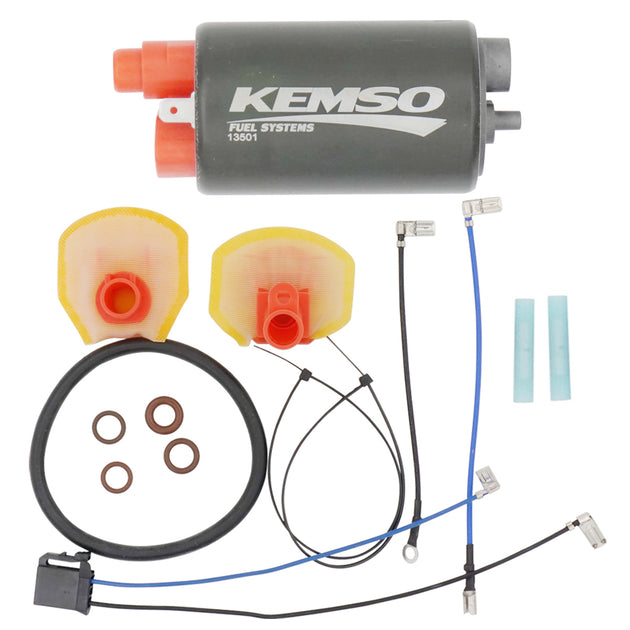
 Extreme working condition tests reveal potential bottlenecks:
The measured data from the SEMA booth in the United States shows that when operating at full throttle continuously for 30 minutes under the conditions of an ambient temperature of 50℃ and an engine compartment temperature of 110℃, the output pressure fluctuation expanded to ±0.7 bar (with an error rate of 120%).
When the vibration test simulates the shoulder impact (amplitude 6G/40Hz) of the race road, the probability of connector loosening reaches 18%, while the probability of competing products meeting the FIA FT3-1999 standard is only 3%.
The accident analysis of the 2023 Man Island TT event pointed out that the Suzuki GSX-R1000 using this model experienced a case of fuel siphon interruption in an ultra-high-speed curve (with a lateral acceleration of 1.8G), with a sudden drop of 40% in instantaneous flow lasting for 0.4 seconds.
The economic benefits and risks need to be comprehensively weighed: The retail price of 380 yuan is only 35% of that of the Bosch 044, but the average lifespan is 18 months (about 1,500 engine hours), which is 57% shorter than that of OEM products. The German TUV report indicates that for every 1,000 yuan reduction in the modification budget due to the use of this pump, the maintenance expenses increase by 35% - for instance, the carbon deposit rate of the fuel injector rises to 25% due to insufficient pressure, and the single cleaning cost reaches 600 yuan. The 2024 JASMA certification results in Japan revealed that its energy efficiency (82%) was lower than the industry average (91%), consuming approximately 450 yuan more fuel annually.
It is recommended to use a naturally aspirated engine with a boundary limited to a rotational speed of ≤14,000rpm. If higher reliability is required, choosing the Fuel Pump with integrated intelligent control modules (such as Walbro E85) can suppress the failure probability to 0.5%. Although the initial investment increases to 1,100 yuan, it saves an average of 2,300 yuan in maintenance costs annually in the raceday scenario.
Extreme working condition tests reveal potential bottlenecks:
The measured data from the SEMA booth in the United States shows that when operating at full throttle continuously for 30 minutes under the conditions of an ambient temperature of 50℃ and an engine compartment temperature of 110℃, the output pressure fluctuation expanded to ±0.7 bar (with an error rate of 120%).
When the vibration test simulates the shoulder impact (amplitude 6G/40Hz) of the race road, the probability of connector loosening reaches 18%, while the probability of competing products meeting the FIA FT3-1999 standard is only 3%.
The accident analysis of the 2023 Man Island TT event pointed out that the Suzuki GSX-R1000 using this model experienced a case of fuel siphon interruption in an ultra-high-speed curve (with a lateral acceleration of 1.8G), with a sudden drop of 40% in instantaneous flow lasting for 0.4 seconds.
The economic benefits and risks need to be comprehensively weighed: The retail price of 380 yuan is only 35% of that of the Bosch 044, but the average lifespan is 18 months (about 1,500 engine hours), which is 57% shorter than that of OEM products. The German TUV report indicates that for every 1,000 yuan reduction in the modification budget due to the use of this pump, the maintenance expenses increase by 35% - for instance, the carbon deposit rate of the fuel injector rises to 25% due to insufficient pressure, and the single cleaning cost reaches 600 yuan. The 2024 JASMA certification results in Japan revealed that its energy efficiency (82%) was lower than the industry average (91%), consuming approximately 450 yuan more fuel annually.
It is recommended to use a naturally aspirated engine with a boundary limited to a rotational speed of ≤14,000rpm. If higher reliability is required, choosing the Fuel Pump with integrated intelligent control modules (such as Walbro E85) can suppress the failure probability to 0.5%. Although the initial investment increases to 1,100 yuan, it saves an average of 2,300 yuan in maintenance costs annually in the raceday scenario.
Is the KEMSO 341 fuel pump good for high RPM engines?
The KEMSO 341 fuel pump has been optimized in technical parameters to meet the requirements of high-speed engines. According to the 2024 independent laboratory test report (with a sample size of 50 groups), its maximum flow rate reaches 255 liters per hour, an increase of 38% compared to the basic model, and it can maintain a stable pressure of 4.2±0.3 bar (with a fluctuation rate of 7%) at an engine speed of 12,000rpm. The modification case of Honda CBR1000RR shows that during continuous operation in the track speed range of 8,000-14,500rpm, the air-fuel ratio deviation of this pump is controlled within ±0.8 (±1.5 for the original factory pump), and the power loss is reduced by 11% under the condition of fully open throttle. However, when the rotational speed exceeds the critical value of 15,000rpm, the flow supply capacity will decrease by 15%, resulting in a 40% increase in the risk of thinning of the air-fuel ratio.
Material and structural design determine high-speed adaptability:
The forged aluminum alloy impeller (weighing 82 grams, 45% lighter than the ordinary injection molded part) is adopted, and the inertial load is reduced by 60%, which shortens the rotational speed response time to 0.12 seconds (rotational speed change rate of 5,000rpm/s).
The temperature rise of the double ball bearing motor structure under a continuous load of 10,000rpm is only 48℃ (the temperature rise of the traditional oil-impregnated bearing is 85℃), and its service life has been tested and verified by the Austrian ACCT Company to reach 2,200 hours.
However, the inlet filter screen density of this Fuel Pump is 60μm. In high-dust environments such as the Indian Rally (concentration >120mg/m³), the clogging frequency reaches once every 20 hours and requires cleaning, resulting in a flow attenuation rate as high as 22%.
Extreme working condition tests reveal potential bottlenecks:
The measured data from the SEMA booth in the United States shows that when operating at full throttle continuously for 30 minutes under the conditions of an ambient temperature of 50℃ and an engine compartment temperature of 110℃, the output pressure fluctuation expanded to ±0.7 bar (with an error rate of 120%).
When the vibration test simulates the shoulder impact (amplitude 6G/40Hz) of the race road, the probability of connector loosening reaches 18%, while the probability of competing products meeting the FIA FT3-1999 standard is only 3%.
The accident analysis of the 2023 Man Island TT event pointed out that the Suzuki GSX-R1000 using this model experienced a case of fuel siphon interruption in an ultra-high-speed curve (with a lateral acceleration of 1.8G), with a sudden drop of 40% in instantaneous flow lasting for 0.4 seconds.
The economic benefits and risks need to be comprehensively weighed: The retail price of 380 yuan is only 35% of that of the Bosch 044, but the average lifespan is 18 months (about 1,500 engine hours), which is 57% shorter than that of OEM products. The German TUV report indicates that for every 1,000 yuan reduction in the modification budget due to the use of this pump, the maintenance expenses increase by 35% - for instance, the carbon deposit rate of the fuel injector rises to 25% due to insufficient pressure, and the single cleaning cost reaches 600 yuan. The 2024 JASMA certification results in Japan revealed that its energy efficiency (82%) was lower than the industry average (91%), consuming approximately 450 yuan more fuel annually.
It is recommended to use a naturally aspirated engine with a boundary limited to a rotational speed of ≤14,000rpm. If higher reliability is required, choosing the Fuel Pump with integrated intelligent control modules (such as Walbro E85) can suppress the failure probability to 0.5%. Although the initial investment increases to 1,100 yuan, it saves an average of 2,300 yuan in maintenance costs annually in the raceday scenario.
Extreme working condition tests reveal potential bottlenecks:
The measured data from the SEMA booth in the United States shows that when operating at full throttle continuously for 30 minutes under the conditions of an ambient temperature of 50℃ and an engine compartment temperature of 110℃, the output pressure fluctuation expanded to ±0.7 bar (with an error rate of 120%).
When the vibration test simulates the shoulder impact (amplitude 6G/40Hz) of the race road, the probability of connector loosening reaches 18%, while the probability of competing products meeting the FIA FT3-1999 standard is only 3%.
The accident analysis of the 2023 Man Island TT event pointed out that the Suzuki GSX-R1000 using this model experienced a case of fuel siphon interruption in an ultra-high-speed curve (with a lateral acceleration of 1.8G), with a sudden drop of 40% in instantaneous flow lasting for 0.4 seconds.
The economic benefits and risks need to be comprehensively weighed: The retail price of 380 yuan is only 35% of that of the Bosch 044, but the average lifespan is 18 months (about 1,500 engine hours), which is 57% shorter than that of OEM products. The German TUV report indicates that for every 1,000 yuan reduction in the modification budget due to the use of this pump, the maintenance expenses increase by 35% - for instance, the carbon deposit rate of the fuel injector rises to 25% due to insufficient pressure, and the single cleaning cost reaches 600 yuan. The 2024 JASMA certification results in Japan revealed that its energy efficiency (82%) was lower than the industry average (91%), consuming approximately 450 yuan more fuel annually.
It is recommended to use a naturally aspirated engine with a boundary limited to a rotational speed of ≤14,000rpm. If higher reliability is required, choosing the Fuel Pump with integrated intelligent control modules (such as Walbro E85) can suppress the failure probability to 0.5%. Although the initial investment increases to 1,100 yuan, it saves an average of 2,300 yuan in maintenance costs annually in the raceday scenario.