Tags, Filters and Search: Cutting a Catalogue Down
Filters are subtractive tools: every one you add removes candidates and time, and the goal is never the narrowest possible result — it is the smallest set that still contains something worth reading. A reader who spends ten minutes scrolling an unfiltered list and finds nothing has usually paid for one extra decision they did not make.

Key takeaways
- Filter order matters. Apply the content filter first, then category, then tags — each later filter operates on a smaller set.
- One narrow tag plus one broad tag usually beats two narrow tags, which can leave a handful of results or none.
- Search rewards specificity; browsing rewards patience. Pick one mode per session instead of alternating.
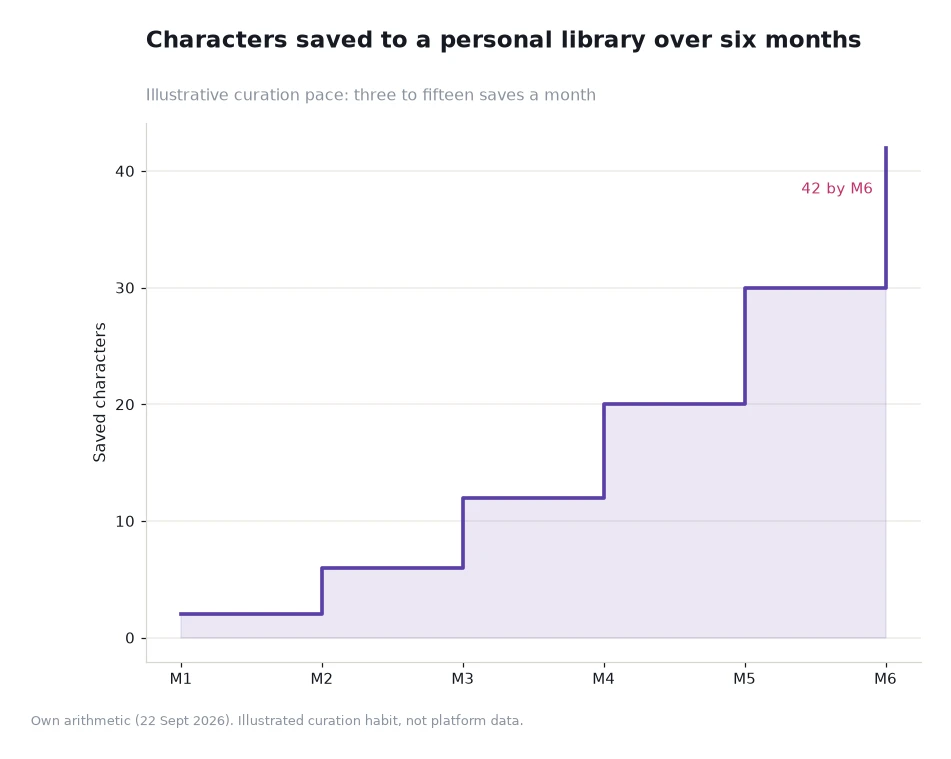
- A filtered routine compounds: the same monthly effort produced a 42-character library in the illustrative six-month curve below.
How the three filter layers stack
The platform exposes filters at different levels, and they are not interchangeable. The content filter — Filtered, Unfiltered or 18+ — decides which part of the catalogue you are looking at before anything else runs. Category and gender options narrow the kind of card. Tags narrow the premise. Applying them in that order keeps every step fast, because each later filter is working on a smaller list than the one before it.
Search carries its own shortcuts. Popular tags are surfaced as a starting vocabulary, which matters more than it sounds: the tag list tells you which words the catalogue actually uses, and using the catalogue's vocabulary is the difference between a search that returns a page of results and one that returns an apology. The search page also links to the weekly rankings for Creators and for characters, which is a useful cross-check when a filtered result set looks thin.
Choosing tags that subtract meaningfully
A useful tag removes something you were never going to read. Broad labels such as Fictional or OC do little work on their own, because most of the catalogue could carry them. Narrow labels do a great deal of work, and their side effect is a small result set. The productive combination is one narrow tag to define the premise and one broad tag to define the register, rather than two narrow tags that may not co-occur at all.
There is also a trap in tag vocabulary itself. Tags describe categories, not quality, so a search that returns twenty results tells you twenty cards share a label and nothing about which of them is well written. That is what makes the description worth a second look: tags get you to a shortlist, and reading the first line of each card is what turns the shortlist into a choice.
Sorting is not filtering, and confusing the two wastes time. Changing the order of a result set — by ranking, by recency, by popularity — rearranges the same cards without removing any of them, so it cannot reduce the amount you have to read. Sorting is worth using after filtering, when the set is small enough that the order matters, and it is close to useless before, when the set is large enough that the order is irrelevant.
| Filter step | What it removes | Effect on your candidate set |
|---|---|---|
| Content filter (Filtered, Unfiltered, 18+) | Everything outside the section you chose | Largest single reduction, and the one worth setting first |
| Category or gender | Cards outside the type you asked for | Cuts roughly by half in practice, depending on how common the type is |
| One broad tag | Cards whose register does not match | Modest reduction, useful for consistency rather than volume |
| One narrow tag | Near-misses on the premise | Large reduction; often the difference between twenty results and three |
| Sorting by ranking or recency | Nothing — it only reorders | Changes which of the survivors you see first, not how many there are |
Worked example
The chart below tracks a small library built from filtered searches rather than from browsing. It is an illustrative curation pace, not platform data: monthly additions of 2, 4, 6, 8, 10 and 12 characters, plotted cumulatively as 2, 6, 12, 20, 30 and 42.
Two readings matter here. The cumulative total of 42 over six months averages seven additions a month, which is well below what a patient browser could save if they kept everything interesting — the point of filtering is that they do not. And five of the six monthly steps, from 4 up to 12, sit inside the three-to-fifteen band the chart's subtitle describes, so this is an ordinary habit rather than an aggressive one. The library grows because the saves are deliberate, not because the volume is large.
Where the browsing time actually goes
Assume an illustrative session of forty-five seconds per card, which is enough to read a persona line and a tag set. Twenty cards is fifteen minutes of reading. A second filter pass that removes twelve of them saves nine of those minutes, and the arithmetic is worth doing before you decide you do not have time to filter properly — the filtering is the cheap part.
The porn ai chat landing page frames the product around characters you can shape, and Crushon's FAQ entry on what Porn Chat AI means describes the same thing in plainer words: a text conversation with a character that adapts as you write. Shaped characters are exactly what filtered search is good at finding — a specific register, not just a category. When a filter combination returns almost nothing, loosen the narrow tag before the broad one, and check whether the catalogue uses a different word for what you want. Five minutes spent learning the platform's tag vocabulary pays back on every search you run afterwards.
Two habits keep a filtered routine honest. Record the combination that worked so you can repeat it, and revisit it monthly, because the catalogue changes and a search that returned three cards in April may return fifteen by September. Keep the working query saved on character search so rebuilding it takes seconds rather than memory. Then use NSFW AI trends as a sanity check on what the wider readership is discovering, and treat the difference between that list and your own saved set as information rather than a problem to correct.
Frequently asked questions
Should I filter before or after browsing?
Before. Filters are cheapest to apply to a large set, and the content filter alone removes the largest share of irrelevant cards.
Why did adding a second tag return no results?
Narrow tags often describe mutually exclusive premises. Keep the narrow tag and relax the broad one, or search the two ideas in the platform's own tag vocabulary instead.
Are popular tags worth using at all?
Yes, as a vocabulary list. They show which words the catalogue actually uses, which is the most common reason a sensible search returns nothing.
Filter first, scroll second
Set the content filter, choose a category, add one broad and one narrow tag, and read only what survives. That sequence turns an unbounded catalogue into a ten-card shortlist in under a minute, and it makes saving a decision instead of a reflex. Run it twice a month rather than every evening and the library stays useful rather than merely large.
Basis for this piece: the platform's search and filter options and its card counters, read 22 Sept 2026[1]. The six-month library curve and the per-card reading times are illustrative assumptions. Read 22 Sept 2026. Adult content, 18+ readers only.